

From details being revealed of a serious problem for one 2026 Formula 1 title contender to a driver’s “best race” in the eyes of his team, the Belgian Grand Prix weekend taught us plenty.
Here’s everything we learned from Spa:
Russell’s power issue only 50% of his problems
George Russell will have felt somewhat vindicated that Mercedes discovered two separate issues with his power unit at the Belgian GP – a deployment deficiency into the final chicane that was costing him 0.2-0.25s in qualifying, and another out of Turn 1 in the race that contributed to him being “swallowed” by the pack and colliding with Lewis Hamilton.
While that Turn 1 exit weakness was shared across all eight Mercedes-powered cars, Russell’s deployment issue into the final chicane was unique to him and explained some of the half-a-second gap he had to team-mate Kimi Antonelli in qualifying.
But it didn’t explain all of it, as his team principal Toto Wolff told Sky Sports F1 “probably half of [the deficit] is to be attributed to the power unit that wasn’t as good as it should have been on his side, and the other side maybe on the driving”.
Russell felt that without a solution to the power unit issues, it will be “impossible” to fight with Antonelli for the title. But even if they’re resolved, it’s clearly not going to be easy to resolve the other 50% of the deficit.
Miami, Monaco, Silverstone and now Spa are all weekends where Antonelli’s had a decisive advantage (even accounting for Russell’s Spa power unit problem). Russell hasn’t had a weekend like that since the season opener.
He was unlucky to be wiped out by Hamilton and Russell says he’s simply “numb to the disappointment now” as “when it happens so often you just get used to it”.
But he can only focus on the things that are under his control. And right now those are decidedly lacking compared to Antonelli, a potentially terminal problem for his title ambitions. – Josh Suttill
Worst 2026 circuits are behind us (hopefully)
It didn’t take long this year (at round one in Melbourne, to be exact) to find out that F1’s 2026 cars are at their worst in the flowing, high-speed corners that fans and drivers so relish.
The combination of not enough energy triggering top speeds to roll over, allied to corner mode piling on a heap of drag to slow them down even more, does not make for a good look when cars go from long straights to fast bends.
It is why Turn 9 in Melbourne was a damp squib, 130R at Suzuka was tamed; why Becketts at Silverstone was not as good as in the past, and why Spa was always going to be, in the words of Oscar Piastri, “sad”.
Although the driver experiences and onboards from Spa left a lot of people underwhelmed, the good news is that F1’s worst of 2026 may be behind us now.
Yes, there are some energy-starved tracks coming up – Monza and Las Vegas are going to be quite difficult – but their characteristics are of just long straights where the speed drops won’t be so in your face, as the super-clipping is done in a straight line.
Montreal proved that losing speed on the straights looks nowhere near as bad as cars being neutered under braking and in the turns, so at least now we can look forward to fewer moans (until we come back to these tracks in 2027). – Jon Noble
Piastri alarmed by handling of Leclerc incident
Charles Leclerc didn’t appear too keen after the Belgian GP to discuss his run-in with Piastri at Les Combes – and generally had the air of someone who suspected he may have got away with one, or at least that it was truly marginal.
Piastri, having positioned his McLaren on the outside of Leclerc’s Ferrari entering Les Combes and taken a hit as Leclerc shifted towards the conventional racing line, lost 0.2-0.3s per lap via the resulting damage, which compromised his ability to preserve tyre life.
And he could scarcely hide his bewilderment at how the stewards – who ruled no further action as they felt that Leclerc wasn’t ‘crowding’ and that Piastri wasn’t far enough alongside and had no realistic chance of completing a move – viewed the incident.
“From where I was at, I was on the white line and got squeezed,” Piastri said. “I think we were very lucky not to have a bigger crash because we touched wheels in the start of the braking zone, basically.
“I don’t really know where I was supposed to go so the fact that was no…I’m not saying it needed to be a penalty necessary, but at least a black and white flag or something like that.
“Because if we think that that’s fine…even just the incentive of knowing that you can leave everyone the absolute bare minimum space and get away with it, that’s not the nicest place to be.” – Valentin Vhorounzhiy
Racing Bulls duel will need management
The very nature of the Racing Bulls team (a Red Bull talent farm with high line-up turnover historically) encourages significant needle between its two drivers, and in Arvid Lindblad and Liam Lawson it has a strong-headed pair with incentives to make each other’s lives difficult.
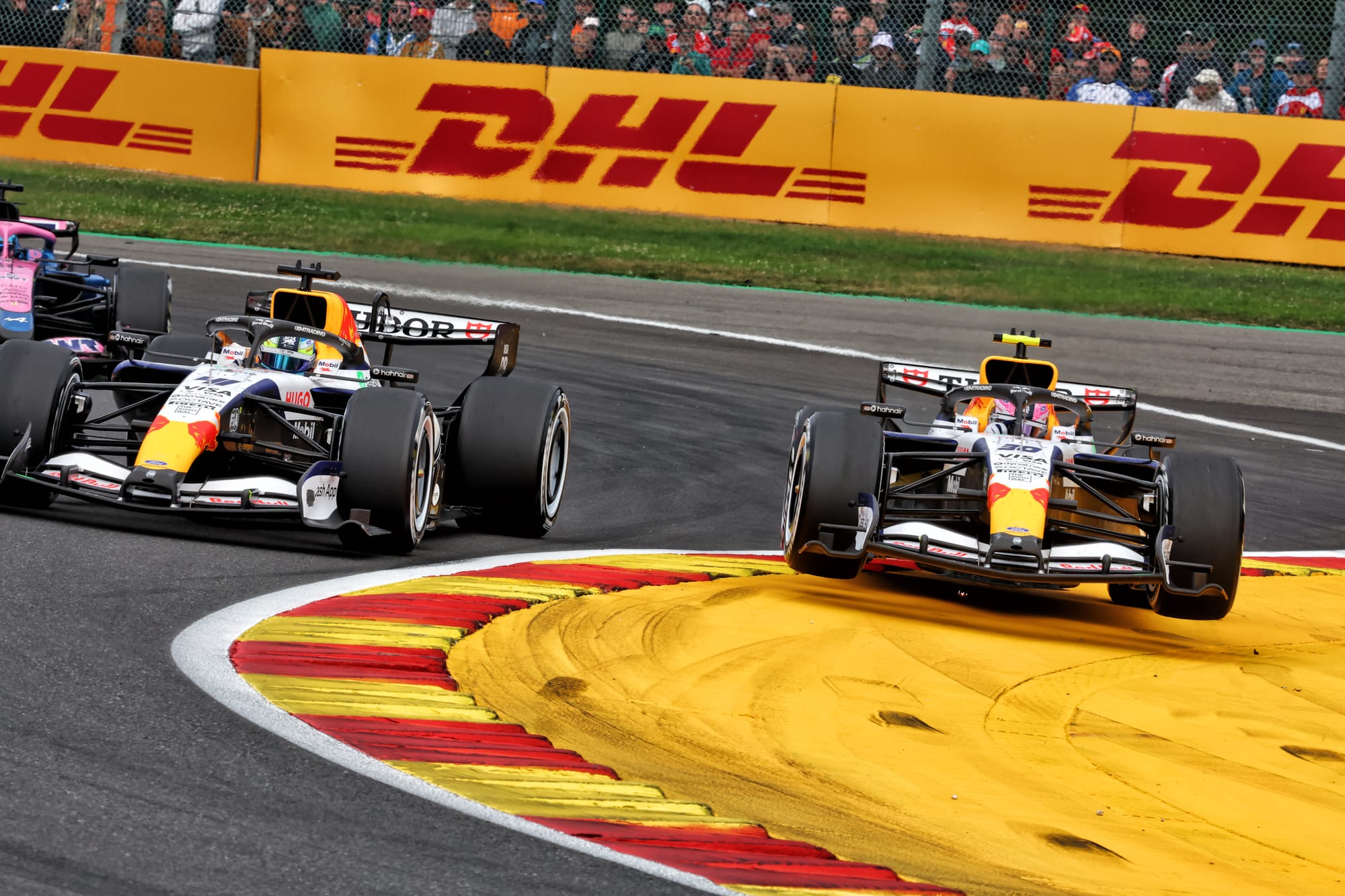
They had a good go at each other in Austria, Lindblad flying under the radar with some flaunting of team orders, and on this occasion, it was a duel featuring a side-by-side run through Eau Rouge – though without the defiance of instructions or frustration on the radio.
Lawson, on the back foot through the weekend in part due to running the less-upgraded car, tried to sneak past Lindblad on the latter’s outlap, first through Eau Rouge, then at Les Combes, where the pair made questionable use of the available track space and Lawson had to hop over the kerb and cut the left-hander.
It ultimately yielded what was probably the better outcome for Racing Bulls, the faster car ahead and able to get on with its race. Lawson made reference to an “aggressive” run-in at Les Combes after the fact, but clearly wasn’t interested in making too big a deal out of it.
No harm, no foul – but signs of potential further trouble up ahead, especially given the car’s status as a midfield-leader and Lindblad’s assured start to life in F1. As team principal Alan Permane said earlier in the weekend: “It’s good to have two quick guys, that’s for sure. I’m sure there’ll be some management needed. They’re incredibly close.”
And it doesn’t feel like the team is particularly fussed about dulling that competitive edge between its two drivers – if the Silverstone shootout-for-the-full-upgrade is anything to go by. – VK
Norris thinks McLaren might’ve had pace to win
After finishing seventh at Spa, Lando Norris described the pace of the McLaren as “incredible”. He even went as far as saying that it “was good enough for a podium, or even to win”, but for his 10-place grid penalty for taking a new energy store.
The speed was certainly eye-catching; even Mercedes spotted it while focused on its own race. Norris started on the hards, was inconvenienced by the timing of the virtual safety car and, by his own reckoning, had 16 seconds added onto his race time thanks to not stopping under the VSC and losing time in the stop when he did pit. He finished 24 seconds behind race winner Kimi Antonelli.
And while McLaren team principal Andrea Stella didn’t go as far as suggesting beating Antonelli and Mercedes on pace would have been possible, he was positive about the speed of the car – albeit cautioning that the characteristics of Spa helped it rather than it being indicative of a breakthrough.
“We are very encouraged by the pace that Lando was able to deliver,” said Stella.
“The car had the pace in qualifying, and based on what we saw, it had the pace to contend for podiums.
“At the same time, the car adapted well to Belgium. And it’s not like if we go back to Silverstone we are in condition to compete for podiums.” – Edd Straw
Hadjar really impressed Red Bull
A weekend that began for Isack Hadjar with the knowledge of a massive grid penalty ended with what Red Bull team principal Laurent Mekies raved was “his best race with us, no question”.
Hadjar had already proven his dedication to the cause with a very tidy execution of a slipstream to Verstappen in Q3, which Verstappen estimated as being worth around 0.3s.
But the grand prix drive certainly carried more weight, as after Red Bull used the early safety car to fulfil the mandatory two-compound requirement, Hadjar scythed his way through the field, then got a ‘cheap’ pitstop under the VSC that set up a chance to even beat Norris – which he duly capitalised on.
Hadjar admitted to mixed feelings afterwards. “I feel like if I do the weekend without any penalties, we are fighting for the podium considering the pace. A shame,” he mused.
“Surprising, as I didn’t believe a track like that would suit us, but not really surprised at my own performance and delivering finally a strong race pace. Clean air at Silverstone was super frustrating for me, not being able to show the pace.”
A cursory glance at his race suggests the bullish assessment is not misplaced. His end-of-race stint on hards stacks up really well against Verstappen’s on the same compound, an average of 1m49.974s to Verstappen’s 1m50.083s.
“Honestly, it’s not only a spike,” Mekies said. “He has been just a little bit better every single race for speed. So he’s bringing some speed every time he’s driving.
“His pace was top-three pace. So very, very happy with his progress.” – VK
Audi’s finally making most of decent car
Audi has long accepted that, despite a strong chassis, its performance this year is being held back a bit by its power unit.
The manufacturer’s first-ever F1 engine has faced a double-whammy of being down on power and not having great driveability. It is too peaky, which is not ideal for this current generation of cars.
But Audi has been chipping away to improve the engine situation – which included a slightly smaller turbo design from the Spanish GP – plus it has been making further gains with its chassis.
That combination appears to have helped it chip away in the midfield to now capitalise better on opportunities such as the one presented at the Belgian GP, where a good call to pit under the VSC helped Gabriel Bortoleto secure Audi’s first back-to-back points of the season.
It has left the team thinking that it is now in a tussle with Racing Bulls for best-of-the-rest status behind the top four teams.
And while Spa’s long straights were not ideal for it, there are venues coming up where things should be better.
As Bortoleto said: “Racing Bulls for now is a little bit ahead of us, but we are catching, we are coming closer and we are coming out of the tracks that [expose more] of our weaknesses.” – JN
Haas solved one problem, but not its biggest
Haas introduced a new front wing at Spa, described by head of car engineering Hoagy Nidd as “quite a big change”. The focus was on improving the characteristics of the tricky Haas VF-26 in terms of consistency.
While the Haas didn’t show stunning midfield pace at Spa, it had the measure of the Williams, which had been a closer battle in the preceding events.
“It [the race pace] shows that we’re in a better place,” said Ollie Bearman after finishing 14th.
“The positive is that the car feels much better to drive. I can lean on it more, I can push it more to the limit and do less mistakes because it’s much more consistent, and that’s good. But we still need to find more performance.”
That chase for downforce will continue with upgrades down the line, while Esteban Ocon in the other car continues to battle with a rear downforce deficit compared to the sister car and a straightline speed problem. – ES