

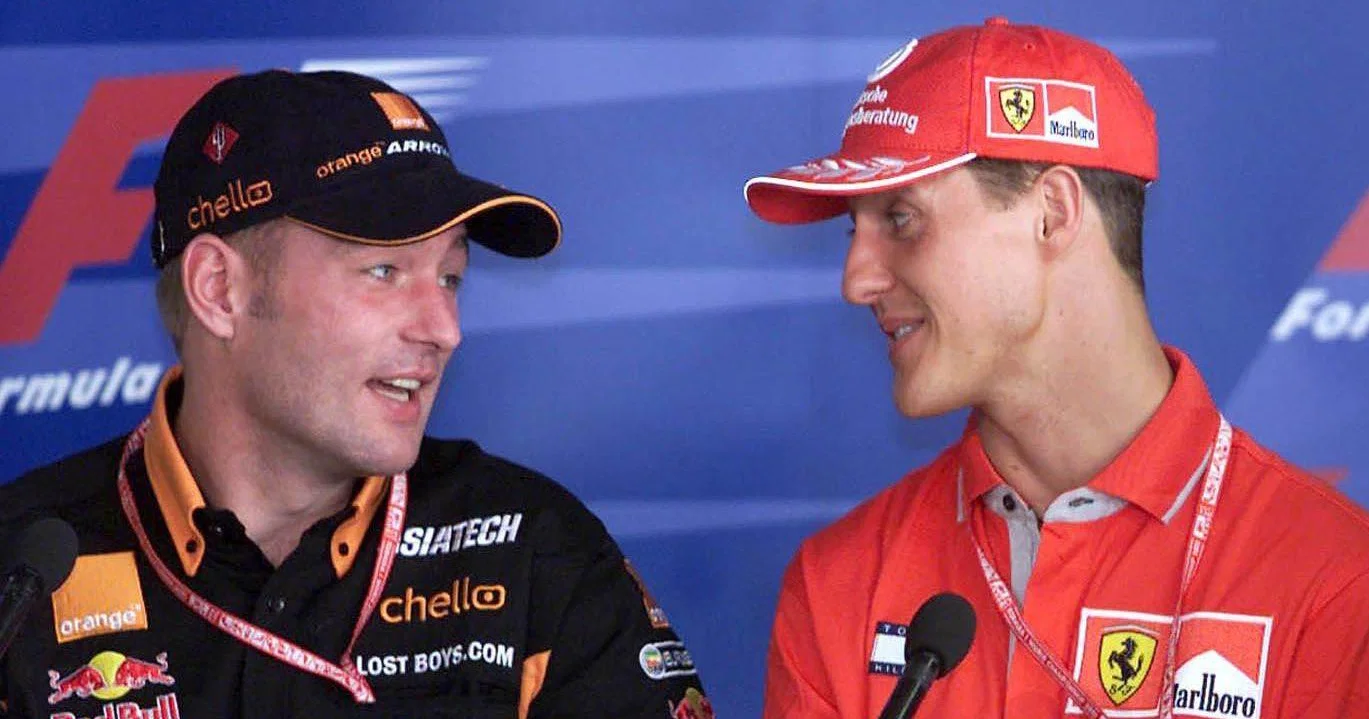
phone call from Ferrari. Michael Schumacher, his former Benetton
team-mate and a close friend, had helped arrange an offer. Jean
Todt followed up personally. The Scuderia was considering
Verstappen as a test driver, and wanted the Dutchman to take part
in a test. He would have been embedded inside the most dominant
operation in Formula 1, but Verstappen said no to the opportunity.
He had a contract with Arrows for 2002 and a race seat; however
modest the team, it felt like the right call over a potential
testing role, however prestigious the employer. It was the wrong
decision. Not because turning down a test role for a race seat is
inherently irrational, but because of what had already been set in
motion four months earlier, on a July afternoon at Silverstone.
Heinz-Harald Frentzen gets sacked Heinz-Harald Frentzen’s final
race for Jordan came at the British Grand Prix on this day, 15
July, in 2001. He finished seventh, and it was not enough to save
his seat. Eddie Jordan had seen enough. Frentzen was fired shortly
after Silverstone, despite holding a contract that extended into
2002. Ricardo Zonta filled in before Jean Alesi took the seat for
the remainder of the campaign. A former championship contender was
suddenly a free agent mid-season, his deal rendered worthless. For
Tom Walkinshaw’s Arrows squad, that availability was too good to
ignore. Frentzen, who spent the latter part of the 2001 campaign in
Alesi’s old seat at Prost, had experience, pace, and the profile to
attract sponsorship. Arrows moved quickly. The problem was that
Arrows already had a driver under contract. Verstappen had
re-signed with the team midway through 2001, securing what would
have been his third consecutive year there. He and his manager
believed the deal was solid. It was not. Arrows signed Frentzen and
discarded Verstappen, casting aside the existing contractual
arrangement entirely. Verstappen pursued legal action for breach of
contract, but the practical consequence was devastating: he spent
the entirety of 2002 on the sidelines, absent from the Formula 1
grid. Arrows did not fare much better. The team collapsed
financially and withdrew from the championship after the German
Grand Prix, leaving Frentzen without a drive of his own before the
season was even finished. What the Ferrari role would have offered
A race seat alongside Schumacher was never a realistic prospect.
Rubens Barrichello was settled as number two and was delivering
precisely what the team required. But a testing role would have
kept Verstappen inside Formula 1, accumulating mileage with the
best car on the grid, building relationships with engineers and
decision-makers at Maranello, and remaining visible to other teams
at exactly the moment his future was most uncertain. Luca Badoer
and Luciano Burti held the test driver positions at the time, and
Verstappen, on merit, was the more accomplished option. Instead, he
watched the 2002 season from outside the paddock entirely, before
returning to F1 for a final season in 2003 with Minardi.
Créditos da imagem: XPB Images